
The state of Louisiana recently mandated the posting of the ten commandments in public schools, a decision which is being challenged as ‘unconstitutional’ and violating the concept of separation of church and state. In 1978 the state of Kentucky enacted similar state legislation which was overturned by the Supreme Court.
The First Amendment to the U.S. Constitution states:
“Congress shall make no law respecting an establishment of religion, or prohibiting the free exercise thereof; or abridging the freedom of speech, or of the press; or the right of the people peaceably to assemble, and to petition the Government for a redress of grievances.”
The words “separation of church and state” do not appear in the U. S. constitution. Many scholars believe that the phrase “make no law respecting an establishment of religion” was expressly included to forestall what happened in 1534 England when the British Crown broke away from Pope Clement VII and established the Church of England.
The founding fathers wanted to avoid the situation which was rampant in Europe where, in many places, the church had overreaching power over the executive, – – – and yet, they did not want to curtail the right of the people to worship as they wished.
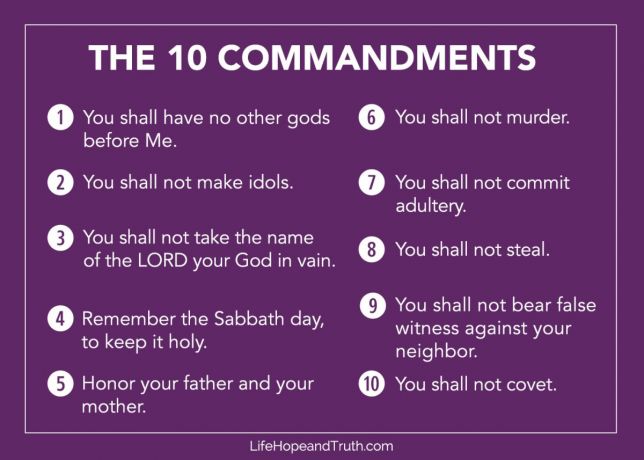
According to the scriptures, the ten commandments were handed down by Moses. Moses (Musa) is a revered prophet for Christians, Jews and Muslims alike. The commandments constitute a tough code of conduct accepted by virtually all religious sects and all law abiding peoples. In them, there is no compulsion to adhere to any religious or political following, no reference to civic involvement, and no attempt to revoke any state or federal prerogative.
So the public obsession with removing all traces of valuable religious teachings is hard to understand. The word “public” seems all inclusive, but I expect the far larger portion of our population is in no way bothered by the notion that their kids are exposed to an exemplary and lofty code of behavior. So those who zealously fight to end any and all public presence of anything that might emanate from accepted religious thought, falsely cite the Constitution but are really showcasing their own personal biases. in my view these people, while most vocal, represent a small minority of Americans.
The founding fathers did not advocate a Godless republic .
—— Just the view of a common man
 Views of a Common Man
Your words are well said and address the issue well. I think we would be well served if we returned to the values we were taught, regardless of one’s religious affiliation. When they took values out of schools, they put in “values clarification” in the curriculum. I’m not sure anyone knew what that meant and it certainly did not seem to catch on. We have seen the results of not teaching basic values and I can’t believe many are happy with those results.
LikeLike
Ollie’s blog is truly a cogent argument that the Commandments are a “tough
code of conduct without compulsion to adhere to any religious or political
following, no reference to civic involvement . . .”. Unfortunately, it can be
argued that they are both religious and ethical directives that are central to
many religions. So the ACLU has filed a legal challenge to Louisiana’s
requirement that the Ten Commandments be displayed in all state-funded
schools and universities on the grounds that it is blatantly unconstitutional.
Ollie accurately states that the words “separation of church and state” do not
appear in the U. S. constitution. So how did those words evolve symbiotically?
In the 1600’s, Roger Williams, a New England puritan minister, was a staunch
advocate for religious freedom, and the separation of church and state. He was a
visionary, a revolutionary, a radical and a rebel. His advocacy for religious liberty,
equality and government free of religion caused him to be exiled from colonial
Massachusetts. He thought that government paired with religion corrupted both.
When the Framers of the Constitution first thought of religious liberty, views
concerning the proper relationship between Church and State varied over a wide
range. The movement for rigid separation of Church and State was strongest in
Virginia where in the 1780’s there was a battle over the proposed revival of the
ancient system of tithing which would have benefitted the dominant Anglican
Church. A bill was introduced to levy a small tax for the support of the clergy,
giving each taxpayer the “privilege” of assigning his payment to whatever church
he might choose. Thomas Jefferson and James Madison opposed the levy, and
the tax was defeated in late 1785.
I don’t disagree with Ollie that a small minority of Americans that are the most
vocal often use the Constitution to showcase their own personal biases. The
genius of American constitutionalism lies in the Constitution which provides
first the opportunity for both change and continuity, and second in the method
of judicial interpretation. There is a saying, “It is often the odd zealots seeking
to make an issue who best defend the rights of others who would suffer in silence,
even though equally aggrieved”.
LikeLike
So well explained, loved it !! Mona
Sent from my iPad
LikeLike